
Technical Implementation
The Demand Management process leverages a variety of add-ons such as ScriptRunner, Tempo, BigPicture, Better PDF Exporter, and eazyBI, enabling a high degree of customisation and automation. Additionally, a bespoke navigation system was designed to help users easily navigate through complex processes.
What are the benefits of introducing a Demand Management system?
Improved collaboration
With the implementation of Jira, the client significantly enhanced cross-team collaboration. The platform enables different departments to communicate and share information in real time, resulting in faster problem resolution and more efficient decision-making. By integrating Jira with Confluence, the client also established a central hub for project documentation, making it easier for employees to share knowledge and resources.
Greater process transparency
Jira enables detailed tracking of every request from start to finish. Management teams can now see the current status of any request at a glance, who is working on it, and the expected completion date. This transparency supports better resource planning and helps allocate work more effectively to critical tasks.
Reduced redundancy and errors
Automation within Jira has significantly reduced the need for manual data entry, which in turn minimised redundancy and the likelihood of human error. Automated workflows ensure that every step in the process is followed according to predefined rules, improving consistency and overall efficiency.
Faster decision-making
Thanks to the centralised request management system, the client has shortened the time required for decision-making. Leadership now has rapid access to all relevant information, enabling quicker analysis and faster decisions. This is especially valuable in dynamic market environments, where speed of response can be the difference between success and failure.
Improved analysis and reporting
Jira offers advanced reporting capabilities that help the client analyse the efficiency of various processes and teams. Management can use this data to identify areas for improvement and monitor the success of different initiatives. These insights are crucial for continuously enhancing operations and aligning business strategies with real-world outcomes.
Increased adaptability
Thanks to Jira’s modular nature and its ability to adapt to different business needs, the client gained greater flexibility in managing projects and tasks. This enables the company to respond quickly to changes in the market or within the organisation while maintaining high levels of operational efficiency.
Demand Management in Jira: A remedy for large organisations
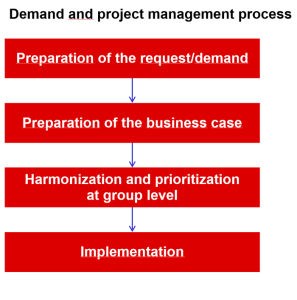
The implementation of Demand Management in Jira has enabled the client to efficiently manage complex requests within the organisation. Through the four phases of the process, the client achieved greater transparency, faster information flow, and improved coordination across departments. The project serves as a strong example of how technology can streamline and improve process management in large enterprises.
For more on business process optimisation, read our article on optimising Jira dashboards to learn how efficient interface organisation can boost productivity.